Introduction
Many of us take modern western medicine for granted, but it has drastically changed in the past centuries. Science, the pharmaceutical industry, the insurance industry and politics all have had a major impact. Through these actors, scientific discoveries have been translated to clinical practice, mostly in the hospital setting. This has led to an enormous improvement in the ability to diagnose and treat various diseases, which in turn has resulted in longer average life-expectancy.
However, when modern healthcare is critically examined it appears that curation is mostly limited to the acute care setting. Examples include, but are not limited to, the treatment of infections with antibiotic therapy, treatment of blood cloths with anti-coagulation and revascularization therapy, treatment of injuries with surgery, pregnancy and childbirth care, intensive care and rescuscitation.
Chronic diseases such as cardiovascular disease, hormone disorders, auto-immune diseases, many types of cancer, neurodegenerative disease, mood-depressive disorder and osteoarthritis, on the otherhand, are much harder to cure. In these diseases, disease control and symptom reduction with various drugs are often the best achievable results.
The truth is that these chronic diseases have actually come to pose the biggest challenge to society, due to their increased prevalence, their detrimental effect on quality of life and their associated long-term health-care utilization and costs. So many lives are disrupted by these diseases. Those that suffer from them have to face many challenges, including medication side-effects, hospital admissions, severe complications and all sorts of loss of function. You will not any longer feel like the person you were before, and you might be forced to compromise in life.
So what actually causes these chronic diseases? For a long time we used to look up to the sky and blaim fate. In the next phase we cursed our ancestors for giving us bad genes. Nowadays, we know that the way we live has an important role to play. Insulin resistance, metabolic fatty liver disease, type II diabetes, obesity, hyperlipidemia, hypertension, sedentary life style, chronic stress and suboptimal sleep are among the most important risk-factors causing these diseases. We know a great deal about how to address these risk factors (more on that in a future article) and should theoretically be able to prevent many (not all) of these chronic diseases.
The problem, however, is that the current health-care system is ill-equipped to address these factors.
A critical view on our current healthcare system
We don’t often stop to consider what health and healthcare really means, do we? Let’s examine it in this paragraph. This will help clarify the shortcomings of the current system.
I can tell you from my own 15+ years of training that medical doctors are typically first trained in anatomy and physiology to get a gross understanding of how the body should function. The processes underlying various diseases are introduced in a later phase. The focus then shifts towards finding the right diagnosis, understanding prognosis and of course therapy. Etiology, or the domain of risk factors and causes of disease, get much less attention. There is close to nothing in the curriculum about health improvement.
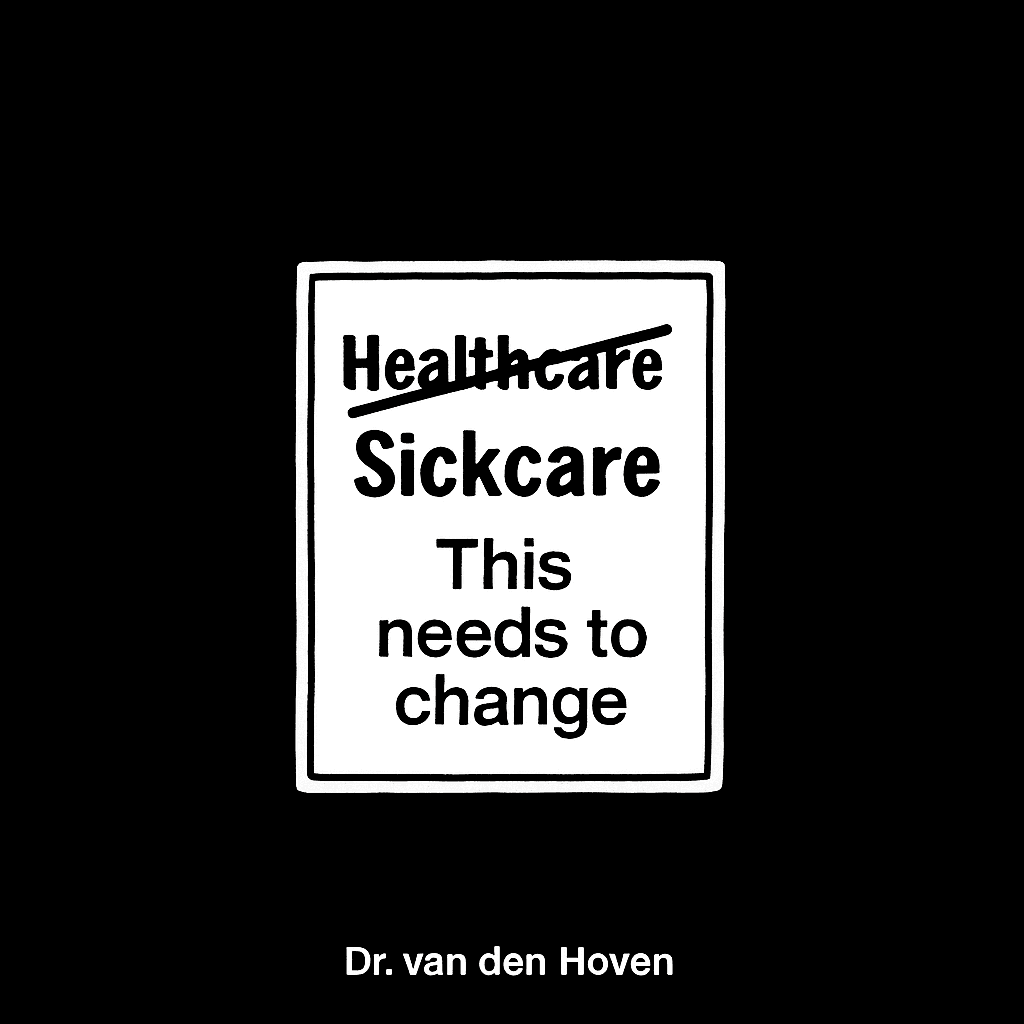
The general practitioner’s office and the hospital are regarded as the two main stages where medicine — in reality only a subset of healthcare — is practiced. The funny thing about the word “healthcare” is that not much care is actually given to “health”, i.e. to preserve or even optimize health. Most physicians will tell you that our job is to diagnose and treat diseases once they have become symptomatic. Why?
Except for cancer screening and some familial genetic testing, trying to catch diseases in early (i.e. pre-symptomatic) stages is still regarded as unnecessary and even unwarranted. Preventive total body scans, for example, are generally frowned-upon in academic medicine.
That seems odd, doesn't it? In medicine, we need validated diagnostic tests to catch or rule-out diseases, but these are unfortunately not fail-proof. False-negative test results (when the test result indicates that the disease is not present, but the patient actually has the disease) would give people an unjustified sense of safety. For example, breast cancer can be missed on a mammogram if the breast contains dense glandular tissue. Moreover, diagnostic test results only give you a snapshot in time. For example, a 'clean' full body MRI could show cancer 6 months later. On the contrary, false-positive test results (when the test result indicates that the disease is present, but the patient actually does not have the disease) often require additional and more invasive tests that could cause complications, for example hemorrhage after an invasive biopsy.
So, we often seem to run into problems trying to diagnose disease in an early stage. Hang on, it gets a little bit more complicated...
Even if we catch a disease early, the question remains whether it affects quality of life or overall survival, and if it does whether treatment can change the course of the disease. In our era of evidence-based-medicine, both questions need to be answered by clinical research before physicians are inclined to intervene. For example, many men die with but not of low-grade prostate cancer. In the majority of cases, it also does not seem to affect quality of life (an enlarged prostate gland does, but that is a separate entity). Because risk of therapy (in this case surgery or radiation therapy) would outweigh the potential benefits, these types of cancers are usually followed-up with laboratory and imaging tests. Only if the cancer transforms into a more aggressive type, treatment is initiated. On the other hand, Alzheimer disease is generally still seen as something that has a detrimental effect on quality and duration of life, but there are no effective therapies on the market. The general assumption seems to be that people would not want to know that they have early Alzheimer’s disease and will inevitably develop dementia later in life, because it will spoil the quality of the remaining asymptomatic years of life.
When you ask medical doctors about effective therapies, they will probably first think of pharmaceutical (drugs) therapies, surgery, endovascular interventions (like a Dotter procedure) or radiation therapy. That is because these are backed by a strong industry with financial incentives and (industry-sponsored) research to demonstrate that their treatment of symptomatic diseases is effective. There is no industry to support lifestyle interventions with the aim to prevent diseases, and it is almost impossible to run randomized clinical trials to demonstrate that these interventions in asymptomatic people (who appear healthy) are effective in preventing the onset of symptomatic disease 5–30 years later.
This all explains why the focus is still on diagnosing and treating disease, only when it has become symptomatic. Accordingly, the term hospital is defined as:
“An institution providing medical and surgical treatment and nursing care for sick or injured people”.
In the Netherlands, our word is ‘ziekenhuis’, which literally translates to ‘sick house’.
We really need a new definition of health and healthcare to address the problems outlined above and realize the full potential of human health.
A new definition for health and healthcare
So, we are exclusively focused on diagnosing diseases once they have become symptomatic and on treating those for which we have scientific evidence (on a population level) that quality of life or overall survival can be improved without risking too much side-effects.
However, most diseases actually have a long period of development, where disturbances of health on a cellular level have to accumulate until tissue disturbances give rise to organ dysfunction and consequently symptomatic disease. This means we might be missing out on the opportunity to prevent diseases from developing in the first place.
We really need to start focusing on health. I don’t view health as a binary state (i.e. an on-or-off switch) but as a continuum for which we have not explored the boundaries yet. People who appear healthy, because they don’t seem to have a disease, may become even healthier and more resilient to future development of diseases.
A huge body of scientific evidence on the mechanistic underpinning and benefits of exercise, nutrition, mindfulness, emotional health and sleep interventions already exists to support this new paradigm. Furthermore, these are low-risk interventions that have very little downside, are scalable and can enhance general joy in life. Of course, there already is some attention for health and lifestyle, but it is not yet integrated into clinical practice and not effectively coordinated. Physicians often tell their patients to start living healthy, eat well and exercise regularly, but leave it up to them to figure out how to make these lifestyle adjustments and stick to them. That does not work and may contribute to a feeling of shame, guilt and frustration in patients.
In order to exploit this concept, we need to start putting as much effort into health as we do into the care of the diseased. We also need to systematically study (bio)markers of health so that we can start quantifying health state, and evaluate the effect of various (lifestyle) interventions on the health state.
Judging by the current state of population health, I think we can safely conclude that we are doing something wrong. If we agree that health is one of the most valuable assets in life, we need to acknowledge that it is hard for people to start engaging in and continue healthy behaviors on their own. We then need to actually help people by providing the right education, effective tools and individual coaching to initiate and maintain positive changes.
I'm confident that this strategy will have a huge return on investment.
It is at the core of everything that I do.
I hope you'll join me on this journey and spread the word.